
Website Relaunch? Why Your New Concept Has to Be “AI-Ready”
A relaunch is no longer a purely visual update today. Anyone rebuilding their website has to build it for two audiences: for people (user experience) and for machines (AI agents). We show you what matters so that your digital heartbeat stays stable in the AI age too.
The days when a website was merely a digital product catalogue are over. In a world where Google serves “AI Overviews” and AI agents search the web for information in order to prepare purchasing decisions, the role of the website is shifting fundamentally.
A modern web relaunch today has to bridge emotional user experience (UX) and technical structure for generative systems (GEO). It is about being not only found, but understood and quoted by AI models as an authoritative source.
User experience (UX): people in focus
If fewer users arrive via classic search, the quality of those who do land has to be used to the full.
- Zero friction: every second of load time and every unnecessary click leads to a bounce. Performance is not a feature, it is the foundation.
- Intuitive guidance: users today expect an experience as simple as a chatbot interface. Clarity beats complexity.
Agents & crawlers: the website as a data source
AI agents such as OpenAI Search or Perplexity crawl your site differently from classic bots. They are looking for connections.
- Structured data: Schema.org is a must in order to give the AI context (Who are you? What do you offer? Why are you an expert?).
- Modular content: today we build websites in “content chunks”. These small, self-contained units of information can be extracted more easily by AI systems and built into AI answers.
Checklist: your web relaunch audit for the AI age
So that your relaunch not only looks smart but also performs, you should tick off the following points:
1. Strategy & content
- [ ] Expertise check: is your content deep enough to serve as a “source of truth” for AI models? (E-E-A-T principle)
- [ ] Chunking: are the texts divided into clear, logical sections that also make sense in isolation?
- [ ] Entity focus: are important technical terms and connections named clearly?
2. Technology & structure
- [ ] Schema markup: is all relevant data (products, FAQs, people, events) backed by structured data?
- [ ] Crawler optimisation: is the
robots.txtset up so that AI crawlers (e.g. GPTBot) are allowed to read your valuable content (or deliberately not)? - [ ] API-first thinking: is the CMS (e.g. Contentful or TYPO3) ready to deliver content to other systems not just as a page, but as raw data?
3. User experience (UX)
- [ ] Core Web Vitals: are all performance values in the green?
- [ ] Mobile first & AI search integrity: does the site work perfectly as a landing page for mobile AI answers?
- [ ] Conversion clarity: after a click from an AI answer, is it immediately clear what the next step is for the user?
4. Monitoring (the new vital signs)
- [ ] Attribution check: do you have a setup for making better sense of “dark traffic” (visits via AI tools with no referrer ID)?
- [ ] Brand mentions: are you tracking whether and how your brand appears in generative answers (LLMs)?
Conclusion:
A relaunch in the AI age is an investment in pre-emptive sovereignty. Anyone who orders their data structure today and radically simplifies the UX extends the lead that the competition will have to work hard to close in two years’ time.
Free whitepaper on the topic
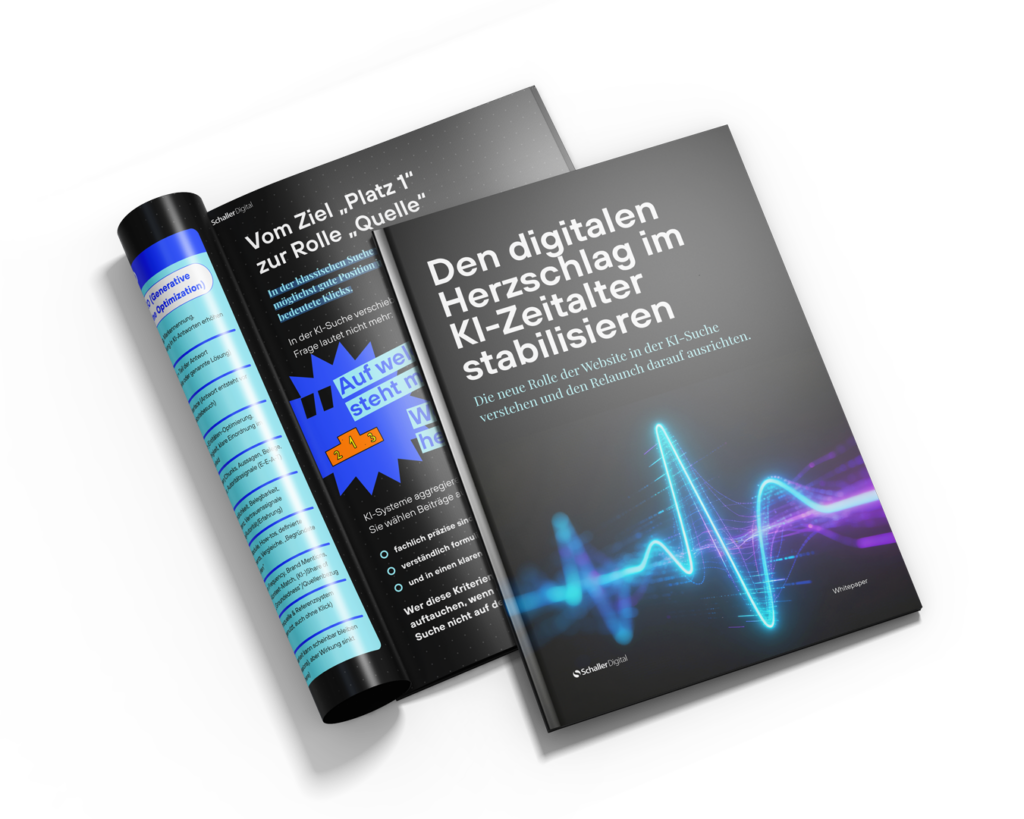
Free whitepaper: Stabilising the digital heartbeat in the AI age. Understand the new role of the website in AI search and align your relaunch with it.