
An enterprise-wide AI infrastructure is the software-based integration of generative language models with internal data sources, automated interfaces, and fixed human control loops. Unlike manual input in isolated chat interfaces, it enables reproducible, data-protection-compliant, and brand-consistent business processes for entire teams.
A common misconception currently prevails in many B2B companies: because employees regularly use ChatGPT to correct texts or experiment with image generators, “AI transformation” is considered to have begun internally. However, real-world experience shows the opposite. As long as artificial intelligence remains merely a tool for individuals, it leads to data silos, inconsistent results, and legal risks.
To transform AI from a casual playground into a measurable value driver, companies must progress through three stages of maturity.
What distinguishes isolated prompting from a true AI infrastructure?
The difference between isolated prompting and an AI infrastructure lies in the transition from uncontrolled, random results to deterministic, systemic processes. While prompting requires individual skill within the chat window, an infrastructure firmly embeds brand knowledge and approvals into the IT architecture.
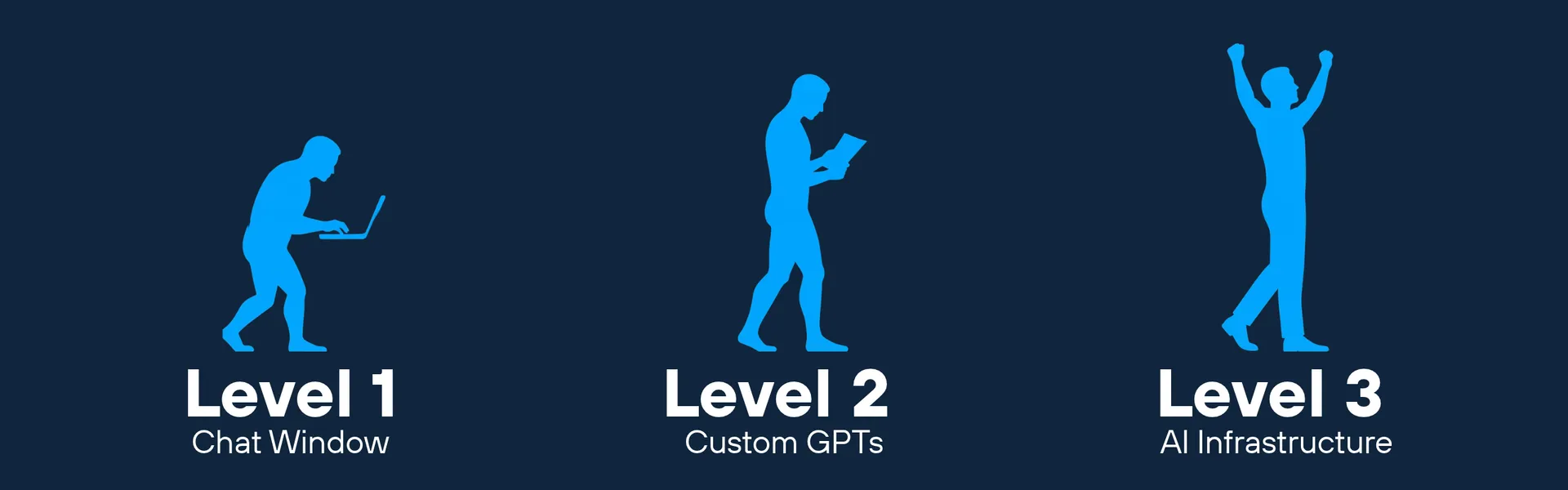
Level 01: The Isolated Chat Window (Experimentation Phase)
Current Situation: Employees use standard accounts on OpenAI, Claude, or Google. Everyone types in their own prompts based on their personal judgment.
The Problem: Results are purely random. The AI relies solely on its general training knowledge; it is unaware of target audiences or brand guidelines and produces three fundamentally different tones in response to three identical requests.
Practical Verdict: Nice for brainstorming, but unsuitable for reliable B2B workflows.
Level 02: Personal Assistants & Custom GPTs (Standardization)
Current Situation: Teams define system prompts and upload PDFs containing product information or corporate design guidelines. The assistants operate in fixed roles (e.g., “B2B copywriter” or “sales assistant”).
The Progress: Results become more consistent as the effort required for prompting decreases and basic rules are established.
The Problem: It remains a standalone tool that must be used manually on demand. Documents quickly become outdated, interfaces to other systems are lacking, and sensitive data is stored uncontrolled on third-party platforms.
Level 03: The Networked AI Infrastructure (Systemic Value Creation)
Current Situation: Specialized AI agents work autonomously in tandem, access internal systems in real time via RAG (Retrieval-Augmented Generation), and are seamlessly integrated with CRM, ERP, and CMS systems.
The Key: Processes run automatically, in accordance with brand guidelines, and securely. Human approvals (“human-in-the-loop”) are an integral part of the architecture.
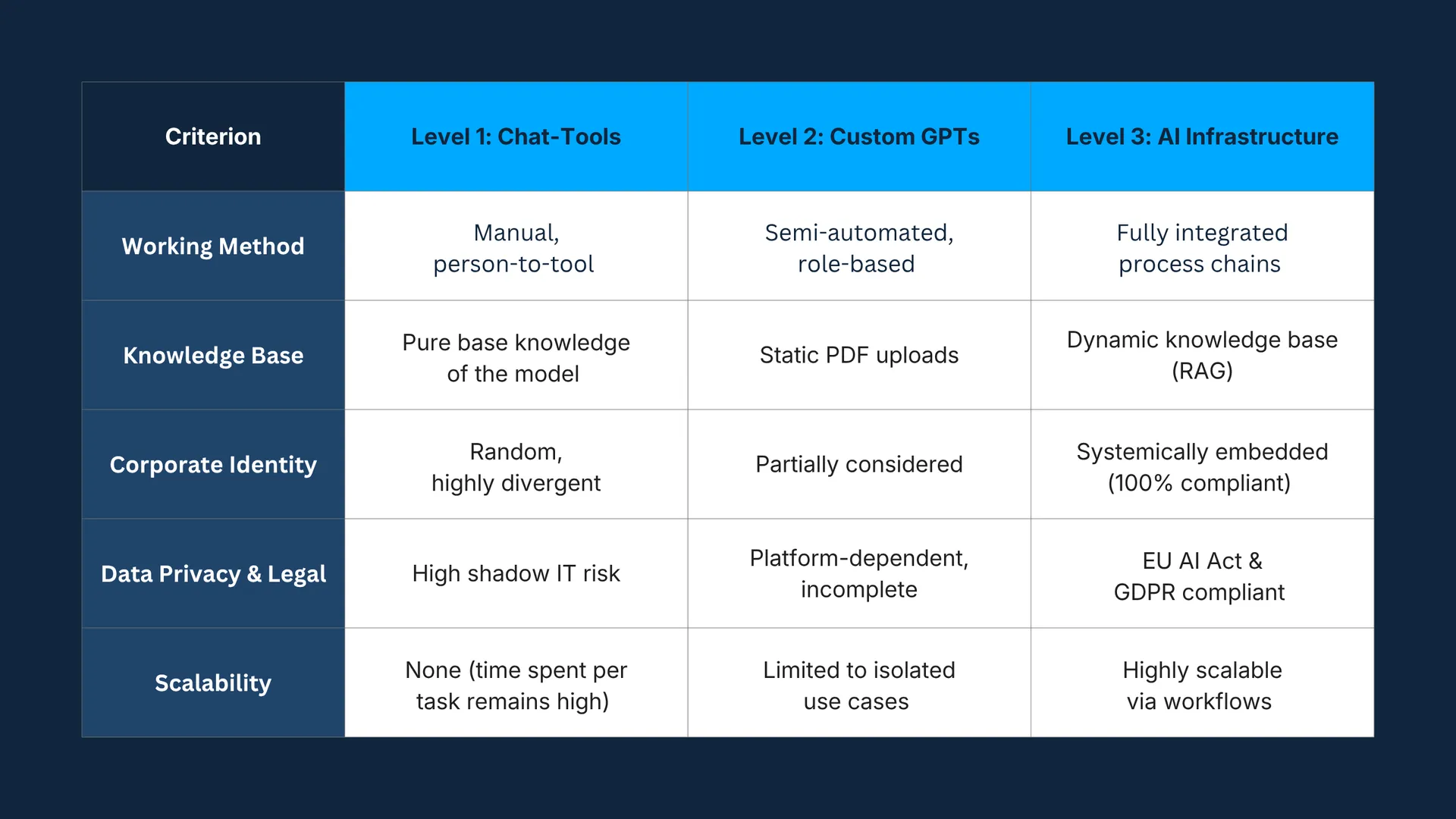
A Direct Comparison: Where Does Your Company Stand?
How does a connected AI infrastructure work from a technical standpoint?
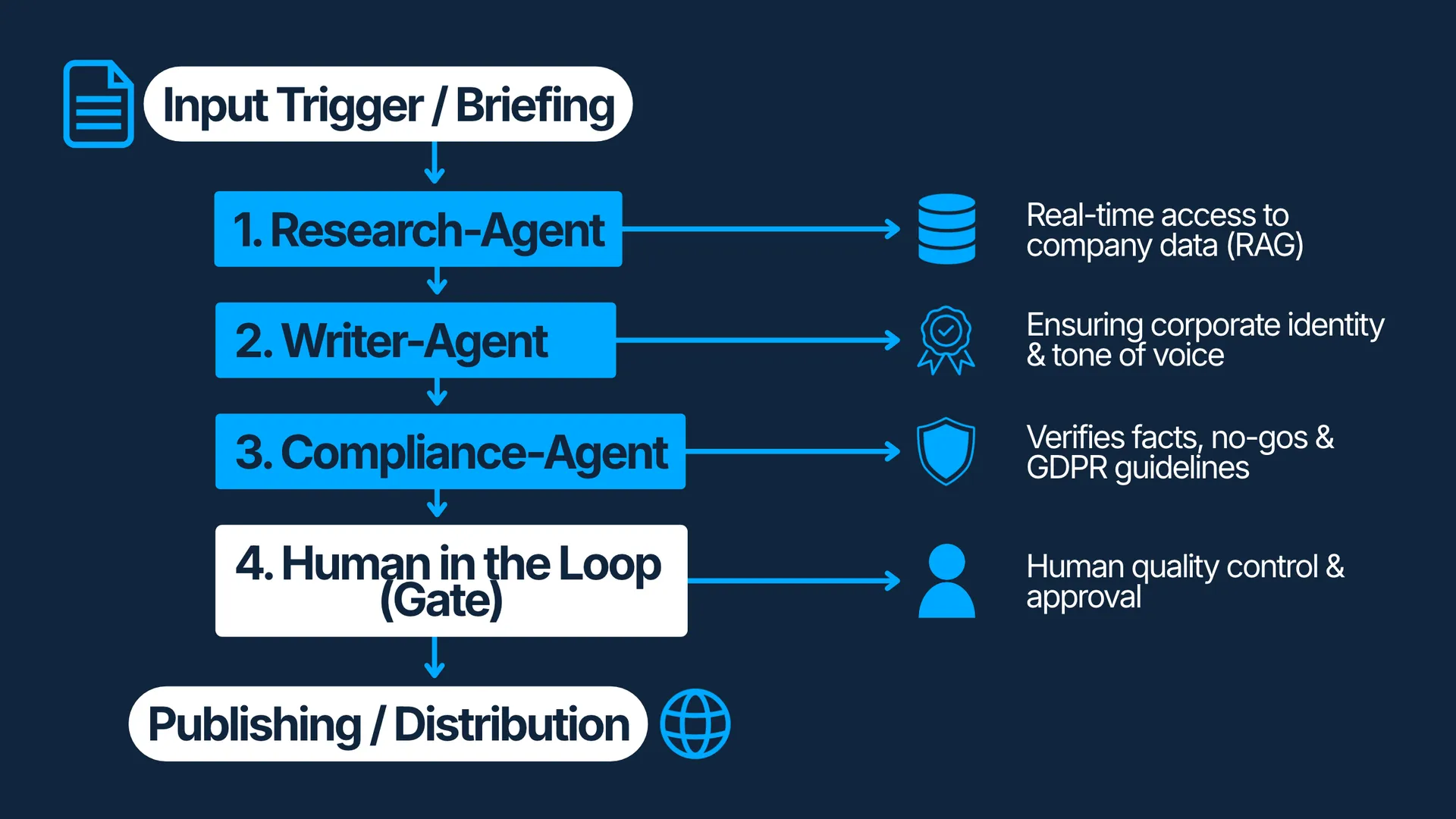
A networked AI infrastructure is based on the interaction of specialized AI agents that communicate with a central vector database via application programming interfaces (APIs). Rather than overburdening a single language model with all tasks, the system breaks down complex workflows into predefined subtasks.
The Multi-Agent System in Practice
A single prompt such as “Write a white paper about our new product” usually results in superficial texts full of platitudes in ChatGPT. In a Level 3 infrastructure, several highly specialized agents share this task:
Research Agent: Searches internal databases, CRM logs, and product documentation for valid facts and metrics.
Structure & Concept Agent: Creates a logical outline based on proven B2B conversion frameworks.
Writing Agent: Formulates the sections in accordance with the defined brand voice and tone.
Compliance & Fact-Checking Agent: Compares the generated text with the source data, filters out prohibited terms, and verifies brand guidelines.
Human-in-the-Loop: The finished draft is submitted to the responsible editor or marketing manager for final review and approval in the CMS.
Why Does AI Fail Without Governance, Data Protection, and Corporate Design?
Artificial intelligence without governance inevitably leads to brand dilution, legal liability risks, and a loss of internal trust. Only when technical safeguards for data protection and brand messaging are firmly integrated into the interfaces can AI be used securely and in a way that is subject to audit within the company.
1. Corporate Identity & Brand Voice as Software Filters
A generic language model always sounds like the average content found on the internet. When customers read text that unmistakably sounds like standard ChatGPT, their perception of professionalism suffers. In a professional infrastructure, sentence structures, technical vocabulary, prohibited words, and the specific brand voice are stored as fixed validation routines. Every generated draft passes through this semantic filter before a human ever sees it.
2. Data Protection & the EU AI Act
Strict guidelines apply to medium-sized companies in the EU:
No model training with customer data: Internal company information, contracts, or customer data must never be included in public training datasets provided by AI providers.
Server location & GDPR: Processing via APIs must take place in secure European data centers or through dedicated enterprise instances with AV contracts.
EU AI Act Compliance: Companies must be able to document where AI is used, how decisions are made, and who is responsible for human oversight.
3. The “Human-in-the-Loop” Principle
AI is intended to lighten the workload for employees, not replace them. Autonomous AI-generated content carries the risk of inaccuracies. The “human-in-the-loop” principle ensures that strategic decisions, the nuances of relationship management, and final approval for publication always remain in human hands. AI handles the time-consuming preparatory work (research, first draft, formatting); humans oversee the quality.
3 Steps to Building Your Own AI Infrastructure: The Implementation Process
The best approach to building an AI infrastructure is to do so step by step, in three phases: identifying worthwhile use cases, technically designing the data architecture, and systematically empowering the workforce. This process prevents costly misinvestments and ensures that new systems are put to immediate use in day-to-day operations.
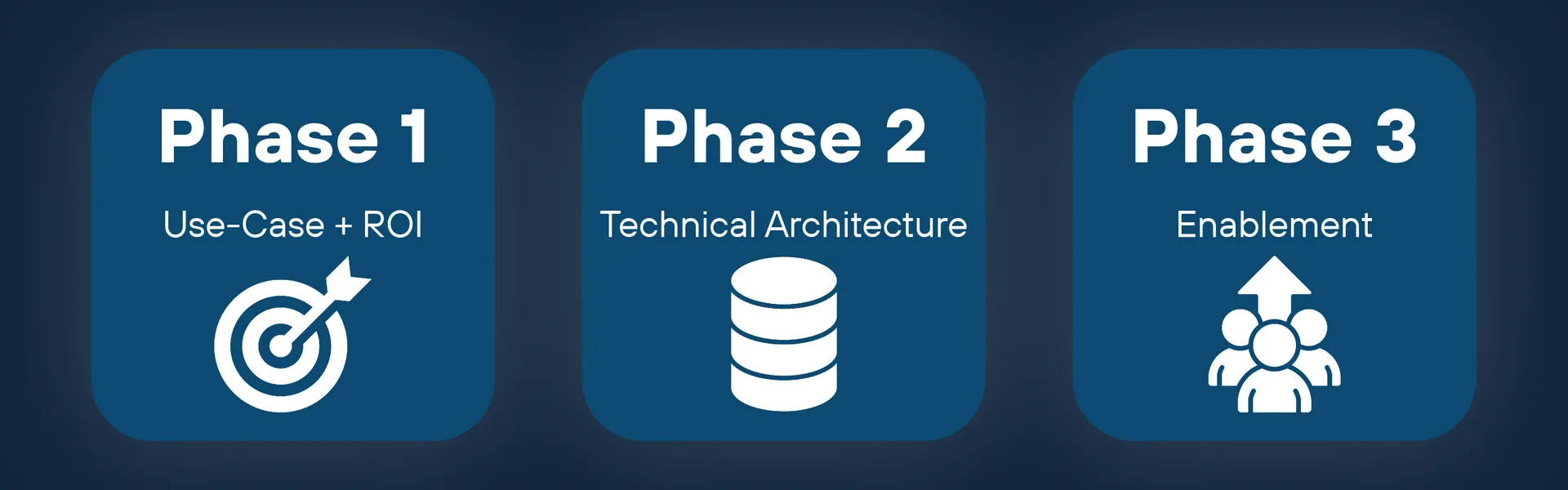
Step 1: Identify Use Cases & Prioritize ROI
Not every process benefits from generative AI. The first step is a sober analysis of existing workflows in marketing, sales, and service:
Where do employees spend hours performing repetitive tasks such as reviewing or processing information?
Which tasks require high data precision with standardized output (e.g., responding to technical requests for proposals, creating case studies, lead qualification)?
Which 1–2 pilot projects promise the fastest measurable ROI?
Step 2: Set Up the Technical Infrastructure and Database
During the technical phase, the groundwork for Level 3 is laid:
Consolidate the knowledge base: Company data is prepared, structured, and transferred to a secure vector database (RAG setup).
Building agents and interfaces: API connections between AI models, CRM systems (e.g., HubSpot), and existing data sources are established.
Defining governance rules: Role and permission models, no-go word lists, and GDPR guidelines are hard-coded into the system.
Step 3: Empower Employees & Ensure Enablement
Software alone does not change corporate culture. Even the best workflow will be ineffective if the team continues to fall back on old habits:
Role-based training: Train teams on the new user interfaces and workflows instead of isolated prompt theory.
Establish feedback loops: Regularly review agent outputs based on actual work results.
Create transparency: Employees need to know exactly how the AI works, what its limitations are, and why it serves as an assistant.
Frequently Asked Questions (FAQ)
ChatGPT Enterprise provides data-protection-compliant access to OpenAI’s standard chat interface. A dedicated AI infrastructure goes a step further: It integrates various language models directly into internal business processes, databases, and software environments via APIs, enabling tasks to be automated without the need for manual copy-and-paste in the chat window.
No, in the vast majority of B2B cases, training your own models is not cost-effective. The modern industry standard is RAG (Retrieval-Augmented Generation). This approach uses existing, pre-trained models but feeds them with internal company knowledge in real time, without the data being incorporated into the model’s public training.
Experience shows that an initial, productive pilot workflow (e.g., a research and content creation agent with RAG integration) can be set up and tested within 4 to 8 weeks. The company-wide rollout and integration of additional departments then takes place in a modular, step-by-step manner.
The leap from experimental use to genuine value creation is not a matter of the number of tools subscribed to, but rather the architecture behind them. Those who lay the foundation today for interconnected systems, clean data, and clear approval processes make their company independent of individual platform trends and build a lasting competitive advantage.
If you’d like to assess where your team currently stands and which workflows in your company are best suited for an AI infrastructure first: At Schaller Digital, we support mid-sized companies in making a pragmatic transition from a chat window to a reliable system - in a well-founded, secure, and collaborative manner.